

I was reading a lot of classic rock biographies around the same time I started playing guitar.
Must’ve been a Senior in high school at the time. And I was jealous.
Partially because of the drug-fueled lives and the borderline-unbelievable stories it led to. I thought that was ‘cool’ at that point in my life. Maybe I sorta still do?
But mostly – and I don’t think I recognized this at the time – I was jealous of the obsession these music icons had with their instrument and craft.
I was really having fun with the guitar, but it clearly isn’t the same for me as for the Jimi Hendrixes and Stevie Ray Vaughns of the world. I had about an hour and a half before my attention would drift, and I’d be ready to do something else.1
And this jealousy wasn’t about the guitar specifically.
Guitar was just a hobby I got into when a torn UCL ended my high school baseball career a bit early. I had time to fill.
But these biographies made it clear that I didn’t have this level of obsession for anything.
I loved baseball – it was a major part of my identity for years. But I also knew I didn’t have the same level of obsession as my peers who were surpassing me. While they were putting in the effort to get ahead, I was happy playing Xbox with my buds.
So I was jealous.
Kobe or Cubicle
“I was probably 10 years old,” Kobe tells CNBC.
“A guidance counselor asked me what I wanted to be when I grow up. I said I wanted to be an NBA player. He said ‘you know, that’s not very realistic. I think you should consider something else.”
Kobe explains to the journalist:
I thought, ‘If this is so hard to accomplish, how in the world am I going to accomplish it if I don’t put all my eggs in one basket? If I don’t focus 100 percent on this, I’m never going to get there.’
These are the stories of success we’re told. Our society loves the story of a prodigy with a freak-of-nature work ethic… the chosen one.

They always knew. They had a singular obsession from day one. They couldn’t not do the thing - even after facing rejection. A level of devotion that led to inevitable success in their field.
But the rest of us?
While we’re told to “follow our passion,” we quietly suspect we don’t have one of those capital-P Passions. Not like that.
We don’t wake up at 5 a.m. craving jump shots.
We don’t lose track of time, being so deep in practice that we forget to eat.
We don’t have that “I’d die without this” energy toward any one thing.
Meanwhile, the other examples we’re shown aren’t exactly inspiring.
It’s the people who dread work, drain their energy doing something they hate, and then spend nights and weekends trying to refill the tank to get through another day.
Those who say things like…
“Everybody hates their job,” and “Welcome to the real world, kid.”
And when those are the two models presented, the unsaid message begins to calcify:
Either you’re born with some obsessive, all-consuming passion… or you’re destined to work a job you tolerate at best and resent at worst.
The problem with passion
(a simple etymology breakdown from Professor GPT)
‘Passion’ comes from the Latin verb pati → “to suffer, endure.”
Originally, it referred to the Passion of Christ, referring to Jesus’ suffering during the crucifixion.
Then usage evolved.
In the Middle Ages, passions referred to strong emotions… the passions of the soul.
From a Christian lens, these passions weren’t celebrated. They were impulses to be tamed, distractions pulling us away from God.
During the Renaissance, usage shifted to what we recognize today. Passion became a way to describe inner desire or enthusiasm, especially in art or love.
Today, we also use it in performative ways:
“I’m passionate about data analytics,” says the candidate in a job interview.
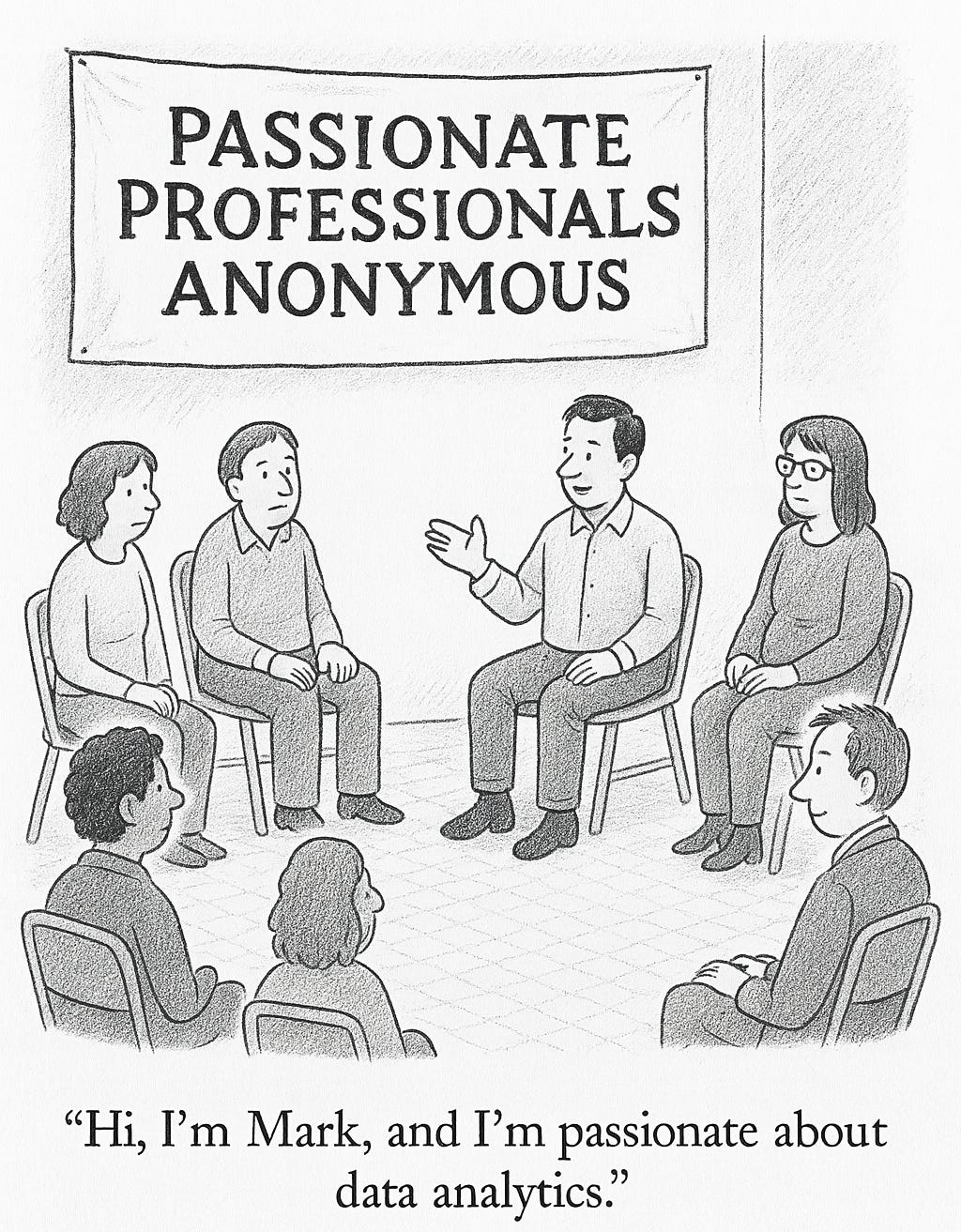
Though we still understand when the use of ‘passion’ is phony, so clearly the word hasn’t completely lost its meaning. We know what true passion is.
And that idea of ‘being overtaken’ by passion still resonates.
Think about that Kobe story.
He clearly made a choice – “I want to be a basketball player.” But on some level, it feels like he didn’t (especially since he was so young).
Overtaken by passion, he was just along for the ride.
This all makes me wonder if the ‘follow your passion’ advice is a sort of cop out.
If passion is something that happens to you, then the absence of it isn’t your responsibility. You’re just waiting for fate to make the call.
“My brother always knew he would be an artist from a very young age.
But me? No, I never found my thing in that way. I’m just an insurance agent.”
It’s difficult to choose your path in life, especially in a world filled with “what ifs”.
So we tell ourselves that others didn’t choose – they were overtaken by passion… they always knew what they wanted to do. It’s an easier perspective to hold.
Otherwise, the responsibility would be on us to make the incredibly hard choice of:
What do I want to do?
So instead, when we’re not overtaken by a passion, we defer to an easier question:
What should I do?
This question has real, concrete answers and data from the world around us. Other people will gladly tell you what’s “smart” or “practical” or “what you need to do.”
We can look to the people ahead of us on the ladder and ask – “am I doing this right?”
But when we ask What do I want to do? there’s no one to answer but us.
A new problem
It’s easy to take for granted how far we’ve come.
For most of human history, career wasn’t a question: You did what your father did, what his father did before him, and the father before that.
Destiny.
Today, we’re handed the opposite set of circumstances. We have the freedom to choose how we spend our working lives – and the potential choices are literally endless.
Like Uncle Ben said:
“With great power comes great responsibility.” And I’ll make a slight edit to that:
With great freedom comes great responsibility.
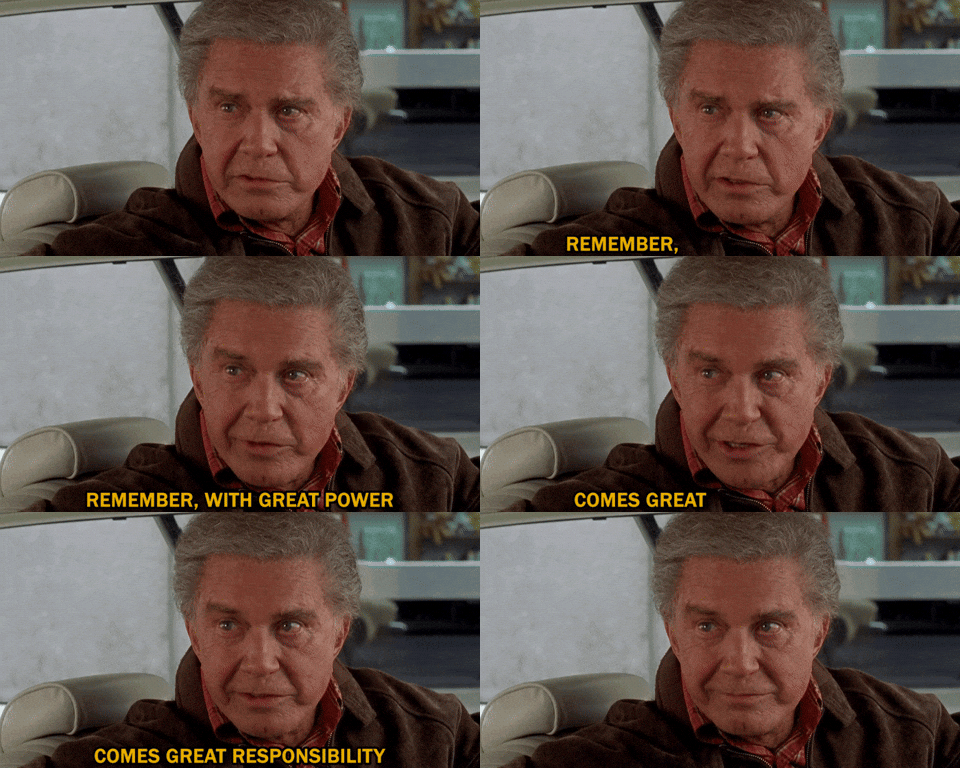
And boy, does that responsibility bear weight. Especially in our secular, capitalist world, where a large chunk of our identity is tied to our occupation. This choice shapes how people see us and even how we see ourselves.
So we dodge that responsibility in a few ways:
1️⃣ We outsource the decision (what should I do?)
2️⃣ We minimize its importance (my job isn’t my life…)
3️⃣ We wait for passion to overtake us (then it’s not our fault if it doesn’t)
The good news
We have a potential path that prior generations didn’t have access to.
The term “lifestyle design” was coined in Tim Ferriss’ book The 4 Hour Workweek, and describes intentionally shaping your work to support the life you actually want to live.
It seems to me that this idea of a “lifestyle business” is seen as sort of silly or non-serious. But after my Father passed much too early last July, I have a very different perspective:
‘Cus he built his own business – he did Business Valuations.
It wasn’t something he had a capital-P passion for. He didn’t care about Business Valuations in the same way Kobe cared for basketball.
But essentially, he built a “lifestyle business” before that term even existed.
He didn’t build a business to scale it to the moon.
He didn’t build a business to chase status and external validation.
He built a business that allowed him to prioritize time with my sisters and me –
He drove us to school every day.
He was at every single one of our baseball and softball games.
He chauffeured us to our friends’ houses.
And since his passing, it’s become apparent how important all this quality time truly was.
The most important, really.
It was only possible because he prioritized spending time with us. And I’m not so sure that’s even possible when working for a company – we can say that our family is the priority, but our actions say the opposite when we miss family dinners and are glued to Slack on the weekends.
So what am I saying here?
I’m proposing a hopeful future. Where a person’s Life doesn’t have to come second to their Work.
I hope for a world with more Freelancers and Solopreneurs, where people work in ways that align with their unique preferences, tendencies, strengths, and perspectives.
Where the average person is presented with more choices than ‘Kobe or Cubicle.’
And it seems to be the way the tides are turning, anyway, which I’m excited about.
Not so people can work less or “slack off” (which is how Corporate Shills tend to frame it).
But so people can do work that highlights their strengths, motivates them, and supports the life they aspire to live.
To me, that feels like a future that’s better for all of us.
So I’ll leave with that hopeful thought.
Thanks for reading!
In an interview, Marcus King describes his guitar obsession:
“I didn’t have any friends. I was just kind of a loner kid… I spent all my hours in the back room with my guitar…TV on, guitar in my hands — that’s all I did.”